
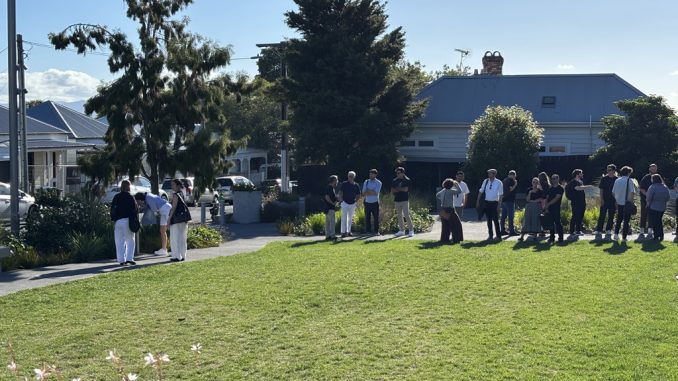
The New Zealand Institute of Landscape Architects (NZILA), Tuia Pito Tāmaki Makaurau Branch designer’s talk, Raumati Kōrero. Held on Thursday, 29 January, 2026.
Hosted by

at Te Rimutahi, 254 Ponsonby Road, Ponsonby, Auckland.
Introduction by:
Bela Hinemoa Grimsdale
Kaihoahoa Whenua_Landscape Architect
Kaiwhakahāere_Studio Manager
It is appropriate to begin this kōrero with the cultural context, history, and narratives that we developed for Te Rimutahi with the support from Mervyn Kerehoma and Graham Tipene from Ngāti Whātua Ōrākei, and Paora Puru from Ngaati Te Ata Waiohua.
For those who may not know, the name Te Rimutahi translates to the lone Rimu tree, a sacred tree that once stood where Ponsonby and Karangahape Roads intersect today.
Te Rimutahi also refers to the Ponsonby ridgeline, a traditional walking track that linked Maungawhau and Te Oka pā.
The track was an important route for trading and interactions between people and resources.
It is interesting to think that these types of activities still take place along this ridgeline today, but just in a different way.
We were very fortunate to be gifted the name Te Rimutahi for this project by Ngāti Whātua Ōrākei.
You will see on top of the canopy, the signage with their specifically designed font that holds significant mana and identity for the iwi.
We also had the pleasure of working very closely with the bro, Grayza (Graham Tipene) to develop the narratives and cultural expression elements within the project.
The overarching narrative being the Rimu tree, which we took inspiration from the leaves, forms, colours, textures, and associated ecologies.
To add to the kōrero, the Rimu tree is a taonga species, as the bark, leaves and gum is used as a rongoa.
We have taken references from the red colour of the wood, berries, sap, and gum, which you will see referenced throughout the site.
There is a narrative that the red colour comes from the Rimu tree absorbing the blood of Tunaroa, a taniwha killed by Maui in a battle.
Rimu is also a hardwood that provided Māori with one of the most effective war weapons, these are the long spears used to defend forts and barricades.
To briefly speak to the cultural expression elements…
The hero being the vertical marker located at the top of the site that references the lone Rimu tree. The marker welcomes you to the site and is a grounding element that embeds the original kōrero and cultural identity of this place within the street frontage.
Basically, a first for this area, especially at this scale and representation for mana whenua identity in this place.
The marker perforations are Grayza’s stylised Rimu leaves and a pūrerehua (moth), the Isonomeutis amauropa that is found in Rimu-dominated forests. The larvae of the moth cocoon themselves under the bark of the tree before transforming into a beautiful pūrerehua.
As you wander through the site, you will also find multiple engraved circular steel inlays that reference the original landscape, such as fallen Rimu leaves and the nearby streams Waikuta and Tunamau that previously flowed from this ridgeline into Te Waitematā – you will see this reflected with the identifiable Grayza tuna style design.

Leave a Reply